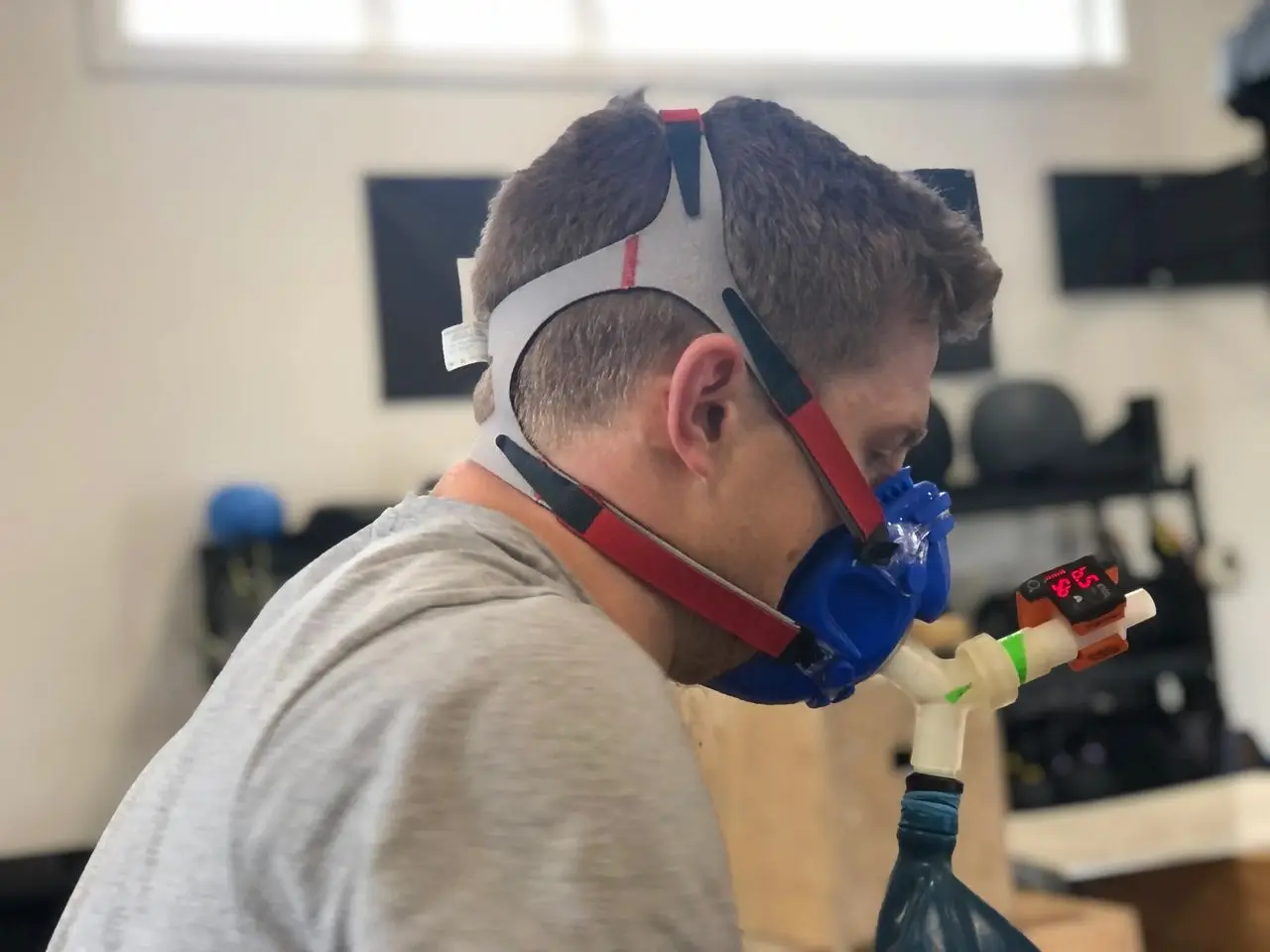
Hypercapnic-hypoxic training lets us work with two powerful variables at once: reduced oxygen and controlled carbon dioxide. I have used this approach with athletes preparing for altitude and in our own field work at elevation. It can be extremely useful, but it is not something to improvise without monitoring, progression, and a clear reason for doing it.
I want to separate what we know, what we have observed, and what still needs to be studied. I also want to make one distinction clear from the start: ordinary BWB respiratory training is not the same as an advanced protocol that intentionally lowers oxygen saturation.
Before getting into the details
- Standard Isocapnic training supports sustained, high-volume breathing while limiting excessive CO₂ loss and supporting normal oxygen saturation.
- Simulated-altitude training uses specific, monitored protocols to lower SpO₂ toward altitude-like levels.
- Hypercapnic-hypoxic training combines reduced oxygen with CO₂ maintained near normal or intentionally elevated, depending on the protocol.
- Acute mountain sickness research is promising but not finished. An independent randomized pilot trial confirmed a rapid improvement in oxygenation with the BWB, but did not establish it as a routine AMS treatment.
- Advanced protocols require monitoring. A pulse oximeter is the minimum. Capnography and practitioner supervision provide substantially better control.
What is hypercapnic-hypoxic training?
Hypoxia means reduced oxygen availability. Hypercapnia means elevated carbon dioxide. Traditional altitude exposure produces hypoxia, while increased ventilation often pushes CO₂ in the opposite direction by causing excessive CO₂ loss. Hypercapnic-hypoxic training deliberately controls both sides of that equation.
The BWB uses a calibrated rebreathing circuit that recaptures a controlled portion of exhaled air while continuously admitting fresh air. The system can support normal oxygen saturation during standard respiratory muscle training. With specific advanced settings and protocols, it can also be used to reduce SpO₂ to altitude-like levels while CO₂ is maintained near normal or deliberately elevated.
This is fundamentally different from an “altitude mask” that simply adds airflow resistance. Resistance can load the breathing muscles, but it does not reproduce the blood-gas environment of altitude. Learn more about the broader distinction in our comparison of isocapnic hyperpnea and resistance breathing trainers.
Four training modes that should not be confused
1. Standard respiratory muscle training
This is where I start almost everyone. Standard BWB sessions train sustained inhalation and exhalation at high volumes while the calibrated circuit limits excessive CO₂ loss and admits enough fresh air to support normal oxygen saturation. The goal is respiratory strength, endurance, usable volume and control, not hypoxia.
2. Simulated-altitude exposure
The Isocapnic app includes established advanced protocols designed to create altitude-like oxygen saturation. Controlled rebreathing lowers SpO₂ while CO₂ is managed rather than allowed to fall unpredictably. These sessions require prescribed settings, pulse-oximetry monitoring and strict safety guidance.
3. Hypercapnic-hypoxic exposure
Some protocols intentionally combine hypoxia with elevated CO₂. This creates a more complex stimulus than altitude alone and allows researchers or trained practitioners to investigate ventilatory control, CO₂ tolerance, oxygen unloading and tissue oxygenation. It is an advanced method, not a casual breathing exercise.
4. Intermittent hypercapnic exposure
The BWB can also be used for intermittent hypercapnic exposure without making hypoxia the central goal. This is a separate research and training direction involving controlled periods of elevated CO₂. Read the supporting mechanism discussion in Controlled Hypercapnia and Mitochondrial Biogenesis.
Why control CO₂ during altitude training?
CO₂ is often talked about as if it were simply a waste gas. It is not. It influences breathing drive, acid-base balance, cerebral blood flow, and how readily hemoglobin releases oxygen. Through the Bohr effect, a local increase in CO₂ and acidity can encourage hemoglobin to release oxygen into working tissue. That does not mean more CO₂ is always better. It means CO₂ is a powerful variable that should be controlled rather than ignored.
At altitude, hypoxia increases ventilation. If ventilation removes CO₂ faster than the body produces it, hypocapnia and respiratory alkalosis can develop. A calibrated rebreathing system creates the opportunity to increase ventilation while reducing excessive CO₂ loss, or to manipulate CO₂ intentionally within a monitored protocol.
For a deeper foundation, read The Physiology Behind Isocapnic Training.
What the research shows
Elite swimmer training study
An eight-week study of elite Croatian swimmers investigated a hypercapnic-hypoxic training program alongside regular swimming. The experimental group reported a 5.35% increase in hemoglobin concentration and a 10.79% improvement in VO₂max. The study supports the potential of combined hypoxic and hypercapnic work, but its specific intervention and population should not be treated as proof that every device, protocol or athlete will produce the same result.
Independent randomized BWB trial at simulated 4,200 metres
In 2026, Kowalski and colleagues published a randomized crossover pilot trial in Scientific Reports. Eighteen healthy, physically active participants completed two sessions in a normobaric chamber simulating 4,200 metres. During the experimental session, participants performed five minutes of voluntary isocapnic hyperpnoea using the sport version of the Isocapnic BWB and the Isocapnic app.
- Average SpO₂ rose from 85.5% to 91.1% immediately after the session.
- Blood oxygen partial pressure rose from 46.91 to 51.76 mmHg.
- The proportion of participants below 90% SpO₂ fell from 83.3% to 22.2%.
- The benefit was acute and transient, with no clear oxygenation difference at the final timepoint.
- Responses varied substantially between individuals.
For us, this was the important part of the study: an independent team reproduced the acute effect we had been seeing in the field. A short Isocapnic session rapidly improved oxygenation during severe hypoxic exposure. The trial did not prove long-term acclimatization or establish the BWB as a complete treatment for acute mountain sickness.
Read the peer-reviewed Scientific Reports study.
Scientific accuracy check: Tomasz Kowalski, an author of the Warsaw study, reviewed our plain-language summary and validated its accuracy, confirming that it captures the study findings well. This accuracy review is not a product endorsement.
From Mount Everest to independent laboratory confirmation
During a rapid 2019 trek to Everest Base Camp, my wife and I used an early BWB system alongside pulse oximetry and capnography. As altitude increased and symptoms emerged, repeated sessions produced a consistent pattern: oxygen saturation rose within minutes while CO₂ remained controlled, and symptoms settled. At the highest elevations, they increased the frequency to four to six sessions per day because the benefit was immediate but did not last indefinitely.
What happened on Everest was an observation, not a clinical trial. It became much more interesting when the Warsaw team independently reproduced the rapid oxygenation response under controlled conditions. The laboratory result does not prove every part of the Everest experience, but it confirms the core physiological signal and explains why repeated short sessions may have mattered in the field.
Can the BWB treat acute mountain sickness?
My answer is encouraging, but careful: the BWB can rapidly and temporarily improve oxygenation during severe hypoxic exposure, and it has promising potential as an adjunct in AMS prevention or symptom management. It is not yet an established routine treatment for AMS.
The Kowalski trial reported that clinical AMS incidence fell from 11.1% to 5.5% immediately after the intervention. However, only a few participants developed AMS and changes in Lake Louise symptom scores were not statistically significant. That result does not disprove an AMS benefit. The two-hour exposure was simply too short to meaningfully test a time-dependent syndrome that commonly develops over 6 to 96 hours.
A laboratory can create longer or overnight hypoxic exposure, but doing so is costly and still cannot fully reproduce multi-day ascent, exertion, cold, dehydration, sleep disruption and hypobaric mountain conditions. The strongest next test would use repeated BWB sessions across prolonged exposure, ideally in a monitored real-altitude field trial.
Altitude safety still comes first. Anyone developing symptoms should stop ascending. Severe or worsening symptoms require descent and appropriate medical care. Supplemental oxygen, medication and portable hyperbaric therapy may be indicated depending on the situation. A BWB session must never delay descent or emergency treatment when HACE or HAPE is suspected.
The six-week altitude-preparation framework
I have developed a six-week framework for athletes preparing for altitude or seeking a controlled altitude-like stimulus. The complete dosing, oxygen targets, CO₂ targets and progression are not published here. They are part of an advanced monitored protocol, not a general-purpose workout that should be copied from a blog post.
At a high level, responsible progression includes:
- Build competency first. Complete the introductory app programs and demonstrate reliable BWB technique before manipulating blood gases.
- Establish individual baselines. Record resting and session SpO₂, symptoms, breathing response and relevant training context.
- Introduce the stimulus progressively. Change one variable at a time and avoid chasing the lowest possible saturation.
- Monitor every advanced session. Use pulse oximetry at minimum. Add capnography when accurate CO₂ control is required.
- Integrate with the athlete’s total load. Altitude work adds physiological stress and must be coordinated with endurance, strength, travel and recovery.
- Reassess the response. Use symptoms, training performance and standardized physiological measures to determine whether progression is appropriate.
I am deliberately explaining the logic without publishing a prescription that an unprepared user could copy unsafely. Athletes or practitioners interested in the monitored six-week protocol can contact info@isocapnic.com.
Internal blood observations and what they mean
In our own pre/post testing, multiple athletes completing Isocapnic altitude-preparation work have recorded changes in hemoglobin and hematocrit consistent with blood-volume adaptation. Estimated plasma-volume changes were calculated from paired hemoglobin and hematocrit measurements.
These observations are encouraging, but they are not the same as a controlled trial. Hemoglobin and hematocrit are both influenced by hydration and plasma volume. Calculations such as the Dill and Costill method estimate relative plasma-volume change under assumptions that may be challenged if red-cell mass changes over a multi-week intervention. The same values therefore cannot independently prove both plasma-volume expansion and increased red-cell mass.
What I take from those results is that the idea deserves formal study. Future validation should standardize sampling time, posture, hydration, recent exercise and analyzer use, and should ideally add an independent measurement of total hemoglobin mass.
Monitoring and safety requirements
Pulse oximetry is the minimum
If the protocol intentionally changes SpO₂, the user needs a reliable pulse oximeter and must understand its limitations. Motion, cold hands, poor circulation, nail products and device quality can distort readings. A single number should always be interpreted alongside symptoms and trend.
Capnography provides better CO₂ control
Capnography is strongly preferred when a protocol depends on keeping CO₂ within a specific range. It allows the practitioner to see whether a participant is becoming hypocapnic, remaining isocapnic or entering a deliberately hypercapnic exposure. This is particularly important when intensity, ventilation or bag configuration changes.
Screening and stop criteria
Do not begin advanced hypoxic or hypercapnic protocols unless you are cleared for exercise and have completed the introductory training progression. People with cardiovascular, neurological, hematological or respiratory conditions, people who are pregnant, and anyone using medication that may alter breathing or oxygenation should consult an appropriate clinician first.
Follow the app, manual and safety guidance. Stop the session if you feel dizzy, lightheaded, confused, unusually short of breath, develop chest pain, lose coordination or otherwise feel unwell. Advanced training should never be performed in water, while driving, while standing in a hazardous location or without appropriate support.
BWB-Sport or BWB-Mask for altitude work?
BWB-Sport is compact, simple and convenient for daily training, travel and short monitored sessions. It is the most versatile starting point for most athletes.
BWB-Mask is better suited to hands-free work, longer sessions and protocols where a mouthpiece becomes uncomfortable. It also allows oral or nasal breathing. Many advanced altitude applications favour the mask for comfort and monitoring access.
Compare both respiratory training systems, or take the respiratory performance assessment if you are unsure where to begin.
Frequently asked questions
Is this the same as training at altitude?
No simulated method reproduces every feature of living and training in a hypobaric mountain environment. Isocapnic protocols can reproduce selected oxygen-saturation and CO₂ conditions in a controlled setting, which makes them useful for preparation and research, but they should not be described as identical to living at altitude.
Does every BWB session lower oxygen saturation?
No. Standard BWB training is calibrated to support normal oxygen saturation while limiting excessive CO₂ loss. Lowering SpO₂ requires a specific advanced protocol and monitoring.
Can the BWB replace acclimatization?
No. Gradual ascent and appropriate acclimatization remain foundational. Isocapnic training may become a valuable preparation or adjunct strategy, but it does not give permission to ignore symptoms or accelerate ascent recklessly.
Has the BWB been studied independently?
Yes. The 2026 randomized crossover pilot trial led by Kowalski used the sport version of the Isocapnic BWB and was conducted at the Institute of Sport, National Research Institute in Warsaw. It confirmed an acute improvement in SpO₂ and blood pO₂ during simulated severe altitude.
Does the BWB treat AMS?
The BWB has independently demonstrated rapid, temporary improvement in oxygenation under severe hypoxia and has promising AMS potential. The current evidence is not sufficient to recommend it as a routine AMS treatment. It should be investigated as an adjunct and must not replace descent, oxygen, medication or medical care when those are indicated.
A frontier in altitude research
The interaction between hypoxia, CO₂ control, cerebral blood flow, oxygen unloading, respiratory conditioning and longer-term blood adaptation remains an important research frontier. The first independent BWB study has already confirmed the acute oxygenation effect that Isocapnic observed on Mount Everest. The next questions are larger: Can repeated sessions improve pre-acclimatization? Can a monitored six-week program produce reproducible hematological adaptation? Can repeated sessions prevent, reduce or help manage AMS across multi-day altitude exposure?
These are questions a good research team can actually test. Isocapnic welcomes collaboration with independent researchers interested in ethically approved laboratory, clinical and real-altitude field studies. We can provide devices, protocol expertise and access to anonymized observational data while protecting participant privacy and the integrity of the research.
Researchers interested in advancing this work can contact info@isocapnic.com.
My final thought
I think hypercapnic-hypoxic training sits on one of the most interesting frontiers in respiratory performance. The BWB makes controlled rebreathing portable and repeatable, and we now have independent evidence that a short session can rapidly improve oxygenation during severe hypoxia. The longer-term questions around altitude adaptation and AMS are promising, but they are not finished science.
My coaching advice is simple. Start with ordinary respiratory training and earn competency before moving into advanced work. Use the right monitoring, progress the stimulus patiently, and never treat the lowest SpO₂ number as a trophy. We are trying to create a controlled physiological stimulus, not win a contest in suffering.
Selected evidence and guidance
- Kowalski T, et al. Effectiveness of voluntary isocapnic hyperpnoea for mitigating hypoxemia and acute mountain sickness in normobaric hypoxia: a randomized crossover pilot trial. Scientific Reports. 2026.
- Luks AM, et al. Wilderness Medical Society Clinical Practice Guidelines for the Prevention, Diagnosis, and Treatment of Acute Altitude Illness: 2024 Update.
- The effects of a hypercapnic-hypoxic training program on hemoglobin concentration and maximum oxygen uptake of elite swimmers.
- Alis R, et al. Corrected whole blood biomarkers: the equation of Dill and Costill revisited.
BWB products are intended for athletic and general wellness use, not medical diagnosis or treatment. People with respiratory, cardiovascular or other relevant medical conditions should consult their clinician before using advanced hypoxic or hypercapnic protocols.
Written by Coach Luke Way. Reviewed by Dr. Andrew Sellars.
AUTHORSHIP AND TRANSPARENCY
About this article
Written by
Coach Luke Way is the founder and CEO of Isocapnic and has coached endurance athletes for 20 years. He specializes in elite triathlon, mountain biking, CrossFit, and physiology-led athlete assessment.
Last updated: August 4, 2026
Product disclosure: Isocapnic Technologies develops and sells the BWB products discussed on this website. Content distinguishes published research, preliminary findings, practitioner observations, and customer experiences. Individual results vary.
Health scope: This content is for athletic and general wellness education and is not medical diagnosis or treatment.