Cory Wallace Case Study: From Respiratory Limiter to Six-Time World Champion

I started working with Cory Wallace in 2008, before the world titles and long before anyone could call him a finished athlete. Our testing kept pointing to the same opportunity: his respiratory system was not yet matching the demands of elite 24-hour racing.

Originally published December 18, 2023. Substantially updated August 2, 2026 with historical testing data, photographs and Cory Wallace’s interview.

There was no single breakthrough workout. Cory and I kept assessing, training, retesting, and taking what we learned back into the field. He moved from early SpiroTiger work to Isocapnic training, tested an early BWB prototype with us in Nepal, and eventually made respiratory work a regular part of his routine. He has since become a six-time World Endurance Mountain Bike Organisation 24-hour world champion.

The respiratory system was that weakest link, and now it’s not.

Cory Wallace, six-time 24-hour mountain bike world champion

Case study at a glance

  • Athlete: Cory Wallace, professional endurance mountain biker
  • Initial finding: 2009 assessment labelled respiratory function as a limiter
  • Measured change: FEV1 increased from 3.5 L in 2009 to 4.97 L in 2014; FEV6 increased from 4.0 L to 6.02 L
  • Training progression: assessment, SpiroTiger work, Isocapnic training and BWB protocols
  • Current routine: 10 to 30 minutes, three or four times weekly, plus selected warm-up, altitude and recovery sessions
  • Competitive record: six WEMBO 24-hour world titles
Cory Wallace competing in mountain biking early in his elite racing career
Cory Wallace early in his elite mountain bike racing career.

The 2009 baseline: strong athlete, identifiable respiratory limiter

Cory’s historical Athlete Physiology Data Collection Form is dated March 28, 2009. At age 24, his recorded spirometry was:

  • FEV1: 3.5 litres
  • FEV6: 4.0 litres
  • FEV1/FEV6: 87%

My handwritten note on the sheet says, “Resp Functional Limiter.” Cory could already ride hard. The question was whether his breathing mechanics, volume, and respiratory endurance were ready for the extraordinary ventilation demands of a 24-hour race. At that point, they were not.

Cory Wallace athlete physiology test form dated March 28 2009 showing FEV1 3.5 litres and FEV6 4.0 litres
The original March 28, 2009 assessment records FEV1 of 3.5 L, FEV6 of 4.0 L and respiratory function as a limiter.

FEV1 is the volume of air forcibly exhaled in the first second. FEV6 is the volume exhaled over six seconds. In adults, FEV6 is commonly used as a practical surrogate for forced vital capacity, although the two measurements should still be labelled accurately.

Capacity was only part of the problem

Follow-up testing showed why spirometry alone does not tell the whole performance story. During a November 2012 cycling assessment, Cory’s tidal volume topped out at approximately 3.2 litres. After pushing to a heart rate near 175 and trying to recover, his tidal volume fell and he compensated with smaller, faster breaths.

The capacity was there, but Cory was not consistently accessing it under load. That changed how I wrote his training. We worked on increasing usable breath volume, improving respiratory coordination, and holding deeper breathing patterns as intensity climbed.

This is a common reason ordinary endurance training can leave a respiratory limitation unresolved. Hard cycling certainly challenges breathing, but it also heavily fatigues the legs and the rest of the athlete. Targeted respiratory muscle training allows the respiratory system to receive focused work without requiring another exhausting ride.

The measured spirometry progression

The cleanest way to look at the change is to compare the same two recorded measures, FEV1 and FEV6, across the years.

DateFEV1FEV6
March 20093.50 L4.00 L
July 20134.86 L5.91 L
July 20144.97 L6.02 L
February 20174.85 L5.85 L
April 20255.10 L6.09 L
April 20264.84 L6.31 L
Selected values from Cory Wallace’s Balance Point assessment archive. Later measurements are included to show both durability and normal test-to-test variation.

From March 2009 to July 2014, Cory’s recorded FEV1 increased by 42.0%, from 3.5 to 4.97 litres. His FEV6 increased by 50.5%, from 4.0 to 6.02 litres. Later testing continued to record FEV1 near 4.8 to 5.1 litres and FEV6 near 5.9 to 6.3 litres.

Those are meaningful changes in recorded spirometry. They are not proof that one device produced the entire result. Cory was completing elite endurance training, strength work, altitude exposure, respiratory training and years of technically informed coaching. Equipment, effort and testing procedures can also introduce variation. What the archive establishes is that substantial and sustained respiratory change occurred during the training relationship.

A respiratory training timeline spanning 17 years

What makes this case useful to me is the length of the record. We are not leaning on one good test before a race or one measurement after a short intervention.

  • 2008: Cory begins working with Coach Luke Way and Balance Point.
  • 2009: baseline assessment records FEV1 of 3.5 L, FEV6 of 4.0 L and respiratory function as a limiter.
  • 2012: exercise testing shows Cory losing tidal volume under high load and compensating with faster, smaller breaths. Training targets volume, coordination and transfer to cycling.
  • 2013 to 2014: recorded FEV1 reaches 4.86 to 4.97 L and FEV6 reaches 5.91 to 6.02 L.
  • 2015: assessment still identifies respiratory fitness as a secondary limiter, showing that a larger spirometry result did not automatically remove every functional weakness.
  • 2017: Cory wins his first WEMBO 24-hour world title. Testing continues to track respiratory mechanics and usable tidal volume.
  • 2019: Cory uses an early Isocapnic BWB prototype at a training camp in Nepal.
  • 2022: written assessments include specific BreatheWay volume, frequency and endurance protocols.
  • 2024: Cory wins his sixth WEMBO title after 434 kilometres and more than 10,000 metres of climbing.
  • 2026: follow-up testing continues, with FEV6 recorded at 6.31 L.

The timeline also prevents a simplistic interpretation. Respiratory development was not “finished” when the first large spirometry changes appeared. Cory and his coaches kept working on how much volume he could use, how efficiently he could use it at different intensities, and how long the system could remain coordinated.

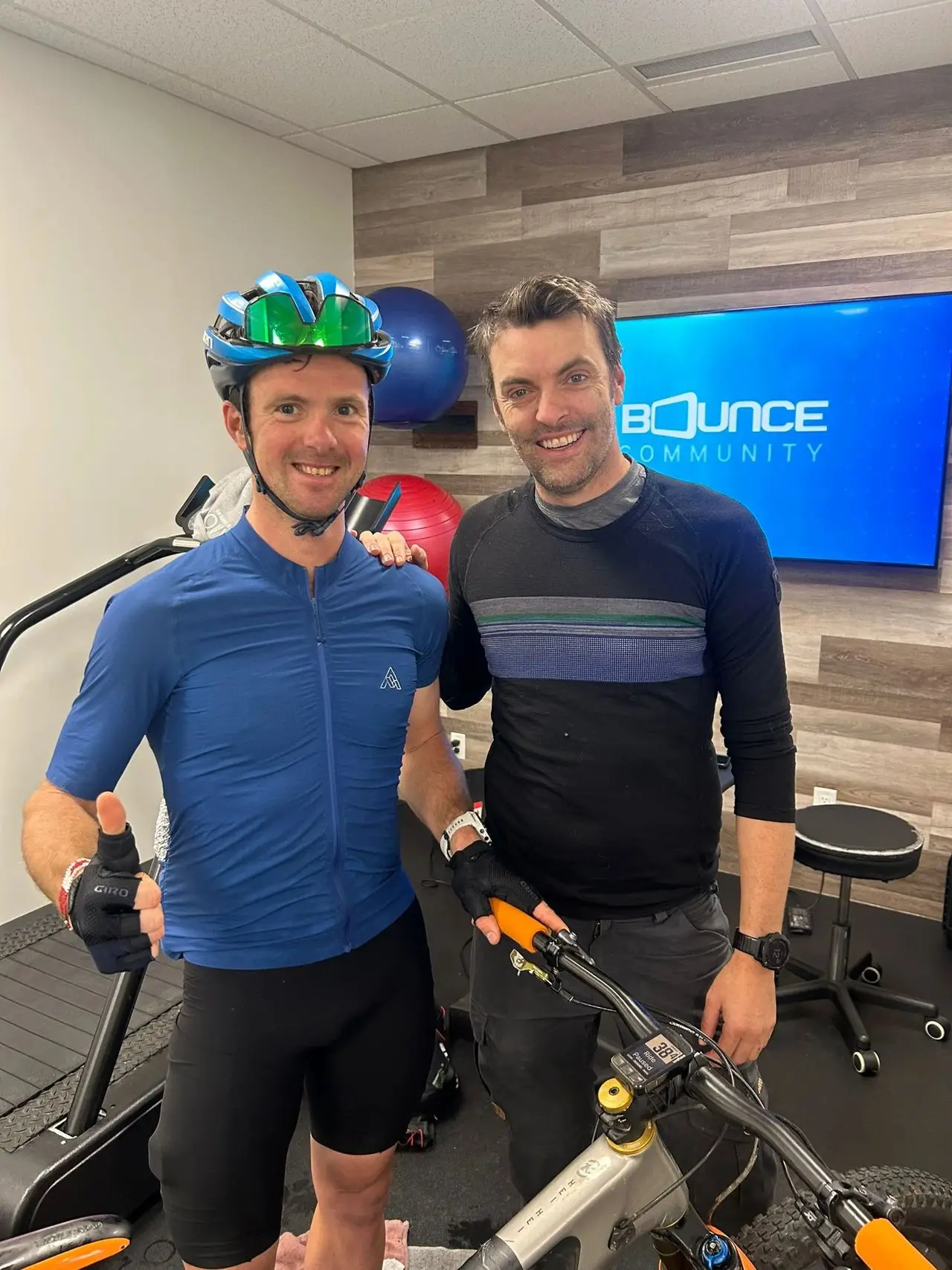
Cory Wallace and Coach Luke Way together after respiratory performance testing in 2013
Cory Wallace and Coach Luke Way after respiratory testing in 2013.

From SpiroTiger to an early Isocapnic prototype

Cory’s respiratory training evolved with the available tools. As he explains in his interview, he initially used a SpiroTiger. He later moved to the Isocapnic system as the BWB was developed.

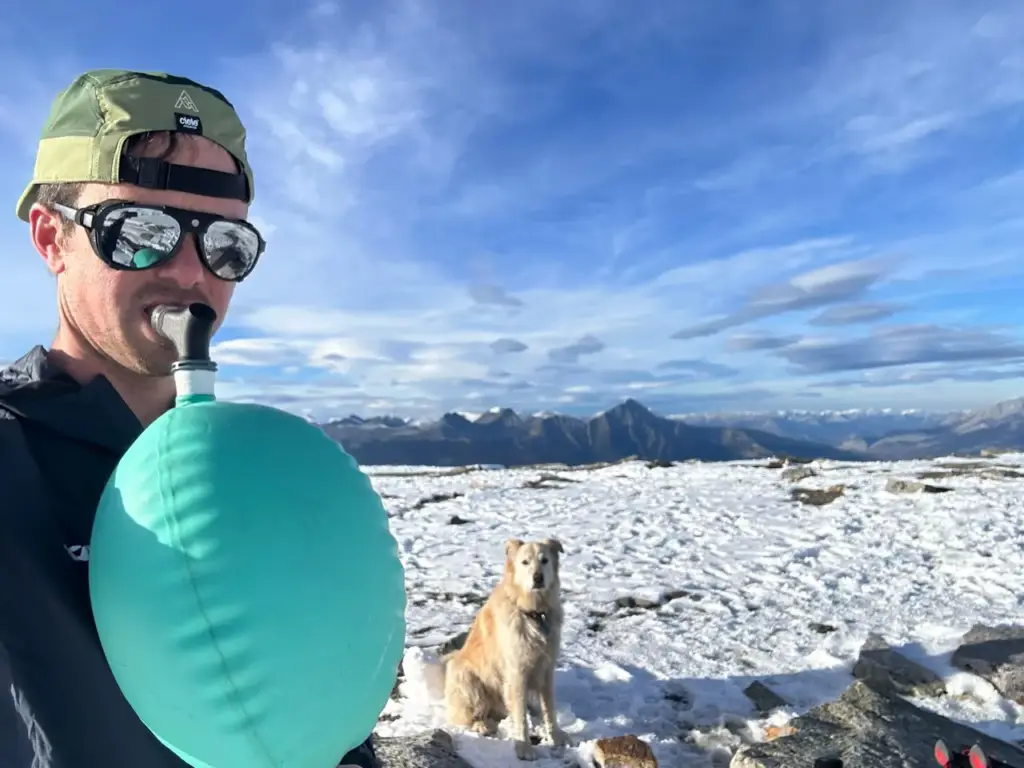
Cory Wallace using an early Isocapnic BWB respiratory trainer prototype at a Nepal training camp in 2019
Cory Wallace testing an early Isocapnic BWB prototype during a 2019 training camp in Nepal. Everyone pictured approved publication.

By April 2022, Cory’s written program included specific BreatheWay sessions:

  1. Four five-minute sets, building respiratory frequency through each set, with two minutes of rest.
  2. Repeated two-minute stages at progressively higher respiratory frequencies while aiming to hold large tidal volumes.
  3. Two 15-minute sets emphasizing sustained, high-volume breathing.

This was not resistance-only breathing work or a handful of isolated breaths. The aim was sustained respiratory conditioning: moving large volumes, coordinating inhalation and exhalation, and maintaining that work for meaningful durations.

Cory’s current Isocapnic routine

Cory has kept the routine surprisingly practical, even around a world-class cycling schedule. He commonly trains for 10 to 30 minutes, three or four times per week. He often completes the session in the morning and also uses short sessions before difficult workouts to open and prepare the respiratory system.

My weakest point used to be the respiratory system, so I wanted to make sure that was caught up to the other systems. Now it’s one of my strengths.

Cory Wallace
  • Regular development: 10 to 30 minutes, three or four times weekly
  • Warm-up: a short session before hard intervals or racing
  • Altitude: sessions during training in Colorado and the Himalayas
  • Stage racing: selected recovery use between stages at altitude
  • Injury periods: respiratory training while reducing load on injured locomotor muscles
  • Travel: a compact training system he carries internationally

His advice for starting is equally practical: begin with two to five minutes, build the habit and use the Isocapnic app to select an appropriate guided workout.

What athletes can learn from Cory’s approach

I would not hand Cory’s advanced workload to every athlete. The useful lesson is that he progressed his respiratory training the same way we would progress any other part of a serious program.

Cory did not begin with 30-minute advanced sessions. His own advice is to start with two minutes, then three, then five. Once the work becomes controlled and repeatable, duration, breathing volume or respiratory frequency can progress. That approach gives the respiratory muscles time to adapt and helps the athlete learn what a productive session feels like.

Placement also matters. A short warm-up can prepare breathing mechanics before a difficult workout. A separate development session can build respiratory endurance without adding another large load to the legs. More advanced altitude or high-ventilation protocols require greater discipline, monitoring and familiarity with the system. The right session depends on the athlete’s current limitation and the work already present in the week.

Cory’s case also reminds me why retesting matters. Subjective changes such as freer breathing and reduced respiratory strain matter, but objective measures help distinguish a real adaptation from a good day. Spirometry, exercise tidal volume, respiratory frequency and sport-specific performance can each provide a different part of the picture.

Why respiratory efficiency matters in a 24-hour race

A 24-hour race exposes small inefficiencies repeatedly. Breathing that becomes rapid, shallow or difficult to sustain can add to the cost of an already extreme effort. Cory describes the objective simply: every system needs to remain economical because by hour 20, every weakness has been magnified.

Towards the end of a 24-hour race, that system is still going strong.

Cory Wallace

Targeted respiratory training did not replace Cory’s cycling. It allowed him to give a previously underdeveloped system additional work without always requiring more fatigue in the legs. For a professional already carrying a very large endurance load, that separation was valuable.

From contender to six-time world champion

Cory won the WEMBO World Solo 24 Hour Mountain Bike Championship in 2017, 2018, 2019, 2022, 2023 and 2024. In 2024 he completed 434 kilometres and more than 10,000 metres of climbing at Mount Stromlo to earn his sixth title. The complete championship history is available through the official WEMBO results archive.

These victories do not prove that Isocapnic training caused Cory’s success. World championships are earned through talent, years of cycling, technical skill, strategy, nutrition, recovery, coaching and countless training decisions. Cory’s case demonstrates something more defensible and more useful: a measurable respiratory limitation was identified, trained systematically and no longer felt like the system holding him back.

It’s kind of a secret weapon.

Cory Wallace on Isocapnic training

What I think this case shows

We have an unusual amount of material for one athlete: historical testing, coaching notes, training prescriptions, photographs, race results, and Cory’s own account. That makes the story valuable, but it is still one athlete’s story.

  • It documents substantial increases in Cory’s recorded FEV1 and FEV6.
  • It documents repeated respiratory assessment and targeted training over many years.
  • It documents BWB prototype use by 2019 and specific BWB programming by 2022.
  • It records Cory’s own experience that breathing changed from a weakness to a strength.
  • It does not isolate Isocapnic training from every other influence on physiology or performance.
  • It does not guarantee that another athlete will experience the same magnitude of change.

FEV6 is a close practical surrogate for FVC in adults, but the historical values are reported as FEV6 because that is the measure recorded. Readers interested in testing standards can review the ERS/ATS technical standard. BWB products are intended for athletic and general wellness use, not medical diagnosis or treatment.

Is your respiratory system a hidden limiter?

Cory was already an accomplished athlete when we found the respiratory opportunity. That is why these limitations are easy to miss. Strong legs and excellent general fitness do not automatically mean the respiratory system has been trained through its full usable volume, endurance, and coordination.

For a deeper explanation of the training method, read the complete respiratory muscle training guide, explore breathing training for cycling, or review the research and evidence.


Sources and review notes

Cory Wallace approved publication of this case study and the accompanying historical materials. Everyone identifiable in the 2019 prototype photograph approved its publication. Percent changes were calculated from the recorded source values. No result is presented as a guarantee of individual performance.

AUTHORSHIP AND TRANSPARENCY

About this article

Written by

Coach Luke Way

Coach Luke Way is the founder and CEO of Isocapnic and has coached endurance athletes for 20 years. He specializes in elite triathlon, mountain biking, CrossFit, and physiology-led athlete assessment.

Last updated: August 4, 2026

Product disclosure: Isocapnic Technologies develops and sells the BWB products discussed on this website. Content distinguishes published research, preliminary findings, practitioner observations, and customer experiences. Individual results vary.

Health scope: This content is for athletic and general wellness education and is not medical diagnosis or treatment.

Read our editorial and scientific-review policy.

Share:

More Posts

Send Us A Message